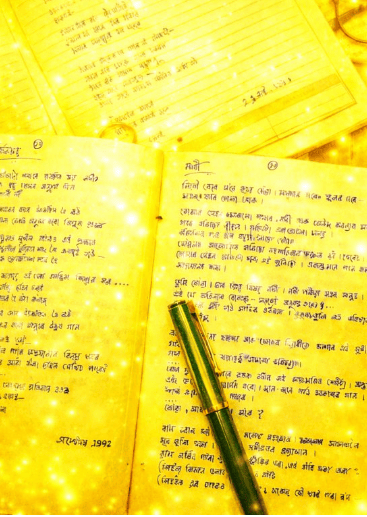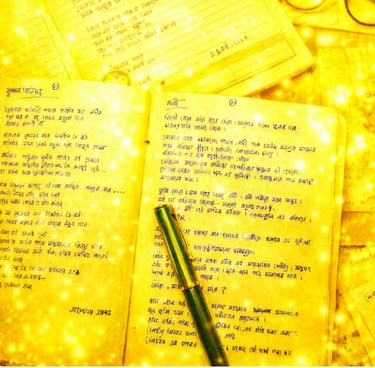

The Touch
(a)
You have lost nearly everything,
just as I have.
Joy and grief are gone,
the sun’s warmth,
the thrill of breath
even the void, the soul of silence.
Unseen,
an invisible plunderer
carried it all away.
And yet you are radiant,
as I am.
We have fastened our souls
to a single, immense post.
(b)
You dream of exquisite food;
hunger and thirst fall away.
The sky becomes a plate,
the stars, roasted grain.
A river narrows
to a cupped palm.
And yet you are luminous,
as I am.
We have given this beautiful city
to pitiless time.
(c)
You sit, all ablaze
as I do.
You hurl your heart—your love—
into the furnace.
Fingers, lips,
home and hearth
like iron under flame,
your body glows, molten.
And yet you are green,
as I am.
We have lent our eyes
to the greenness.
(d)
Slowly, this world has begun to displease you,
as it does me.
You cross beyond its limits;
in vast emptiness
you paint the world—
you paint time,
you paint smiles.
Your art is filled
with all that we never found.
And yet you return,
as I do.
We leave the wounds behind,
beyond the world.
(e)
You are gravely ill,
you have lost all memory—
as I have.
You forget your birth-star,
your name;
every art slips away.
By mistake
you search my pocket
and find my heart.
You claim it as your own.
Yet you remain unloving,
as I am.
_________________________________________
1993, Guwahati – 2005, Tezpur
First published: Srimayee, Autumn Issue, 1993
Editor’s Note
The Touch unfolds in five linked movements, each structured around parallel voices of “you” and “I,” creating a shared field of experience rather than a personal confession. Loss, hunger, love, art, illness, and forgetting appear not as isolated events but as stages of a single inward journey. Repetition—especially the recurring affirmation “as I am”—binds the sections together, emphasising identification, mirroring, and mutual endurance.
Stylistically, the poem is spare and incantatory. Short lines, elemental imagery (fire, food, light, greenness, emptiness), and restrained syntax give it a ritual quality. Meaning emerges through accumulation rather than explanation: deprivation gives way to radiance, hunger becomes vision, suffering turns into creation. The poem ultimately gestures toward a shared, unresolved state of being, where identity, love, and memory blur, and survival itself becomes a quiet, collective act.
Select language
© 2026. All rights reserved.




Reach out for questions & collaboration
+91-9954060665