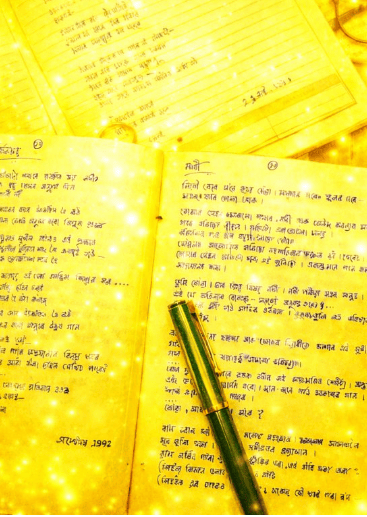
Hunger
In the deep of silence
your voice still quivers.
A song never sung returns,
echo on an echo—
the slow dance faltering, falling away.
its last shape spent.
Shiva, unending,
Is uttered.
Now the walls close in,
unspeaking.
Dreams draw close,
huddled in the ribbed dark
of the chest.
Within your gaze
the redness of eventide
lies under a curse.
Who comes, who leaves—
along the grain of stone,
riding the spirited horse of youth
whether your voice reaches here
or not.
A thousand stars
snared in their own meshes;
the evening wind circling back
along death’s track,
out of time.
The twin warders stand—
reverent, still.
____________
5 August, 1995
Editor’s Note
Hunger privileges tone and poetic restraint over literal equivalence, allowing the cultural and musical resonances embedded in the metaphors of famine, Bhairava, and Tal-Betal to remain partially veiled. This deliberate opacity preserves their sonic and symbolic intensity.
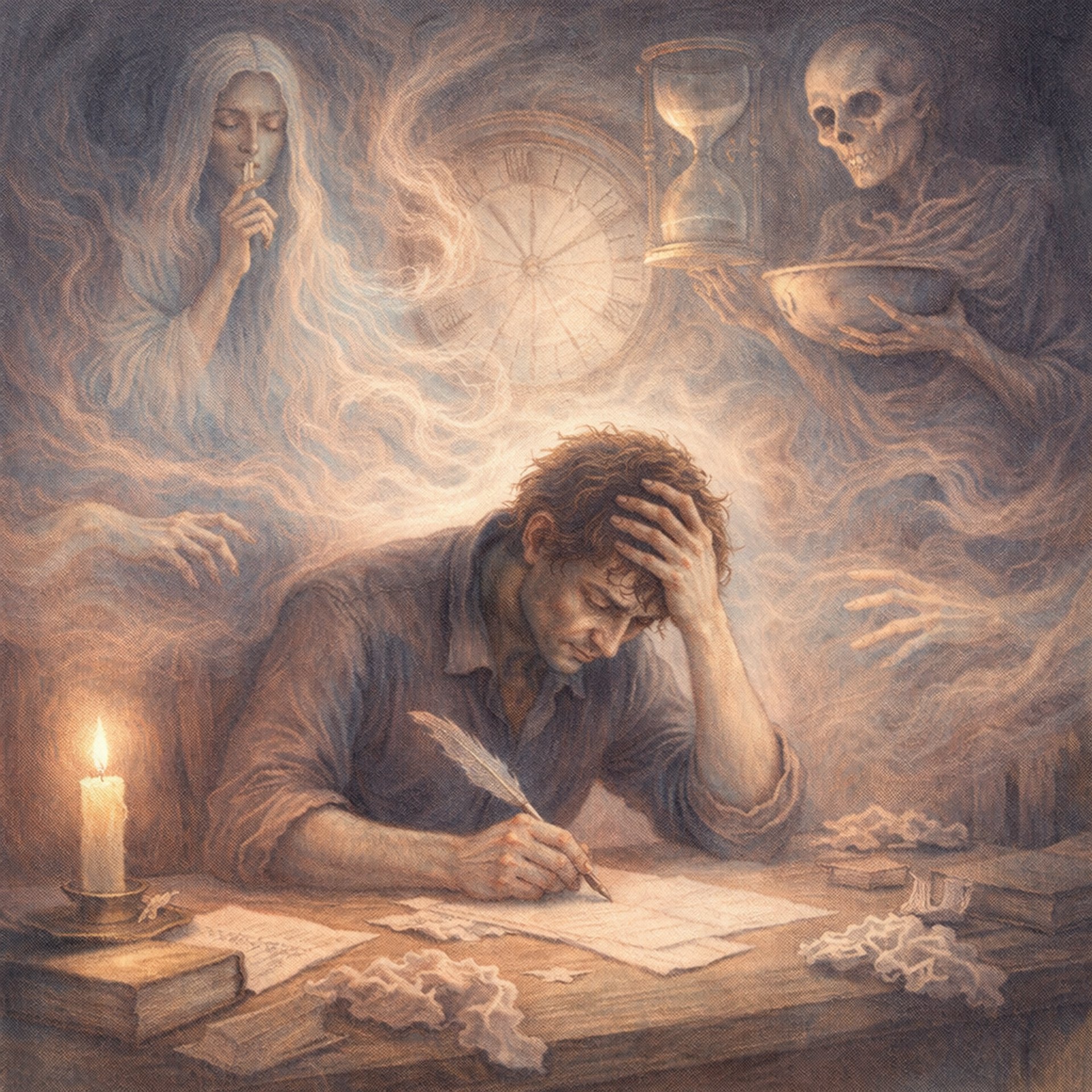
At its core, the poem stages the poet’s psychological struggle with silence, hunger, and time. Hunger here exceeds the physical; it functions as a signifier of longing, memory, and presence. The voice shifts between clarity and obscurity, and it is precisely within this uncertainty that the poem finds its form. Images of timelessness, evening hues, and suspended moments gesture toward a fractured sense of time and an acute awareness of mortality. Hunger thus emerges not merely as physical or emotional lack but as an existential condition—a yearning for transcendence.
Stylistically, the poem moves with a rhythmic, mantra-like cadence, mirroring the depth and persistence of the longing it seeks to articulate.
Select language
© 2026. All rights reserved.




Reach out for questions & collaboration
+91-9954060665